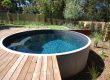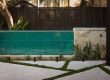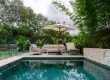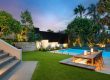
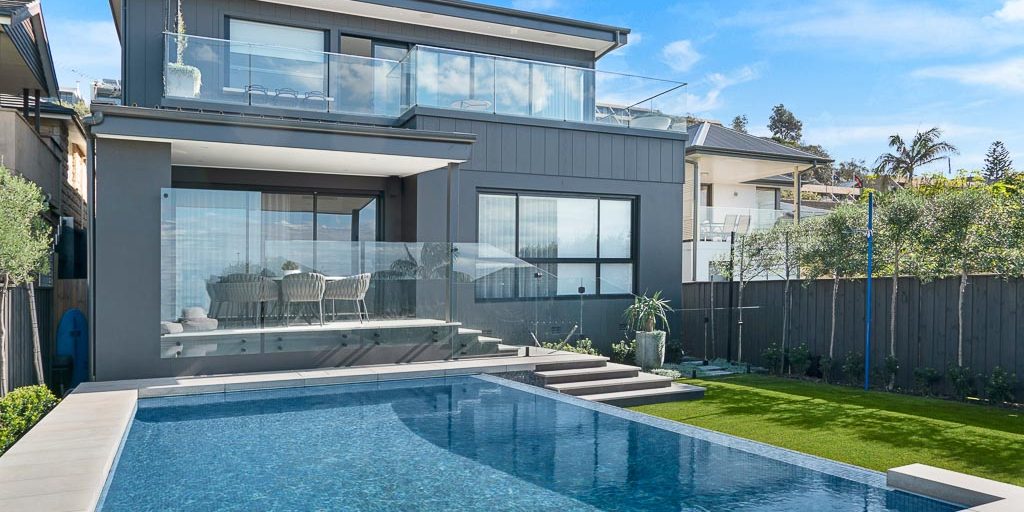
Our landscape designs are highly customised and meticulously planned. Nothing is included without careful thought, planning and consultation. Nothing is dropped in without regard to its relationship to other elements. That’s especially true of pools. A pool isn’t just a checkbox on a list of elements for a backyard design. Swimming Pool design matters.
Swimming pool designs: form and function
Swimming pools are for swimming. They’re also for cooling the air, and they help shape the aesthetics of a space. When our clients use their pools, they use them at different times and in different ways. They might be used for an early morning or an afternoon exercise session, and that exercise might be swimming, water running or water aerobics. They might be a place for a guest to dangle their feet on a hot day. They may be for young children to wade in or for adults to cool down, relax or even get a nice massage. Every one of those uses can affect the physical form of the pool: where it should be located, how it needs to be shaped, how large and deep it will be, how it will be built and how it can be accessed.
Pools might have functional or decorative add-ons like deck jets, massage jets or waterfalls. They also require security and safety features to protect young children and animals from harm. They might even have fish or plants. There’s no doubt that when it comes to landscape design, a pool is never just a swimming pool.
A pool might be integrated with built elements like an outdoor room or a canopy. Swimming pools that are designed for socialising might include a hot tub and a children’s wading area. Pools provide evaporative cooling on hot days, and they can be placed so that they’ll cool and enhance every outdoor gathering. We can place a picnic table on a deck overhanging the pool, and you’ll have a comfortable outdoor dining area.
Swimming pool designs in formal gardens
A pool in a formal garden should always harmonise with the design.
A classical garden calls for a pool in a regular, prismatic shape that’s designed to work with the flower beds and the other planned elements of the design. It might have a fountain or a statue associated with it. It might feature hand-made decorative tile. Even with a formal, classical design, a pool can be used for swimming, and it will always be cool and pleasant to sit and walk beside.
In a naturalistic garden, the pool will likely be styled to resemble a natural pond or basin. The pool or part of the pool might be shallow and enhanced with plants or with fish rather than being reserved for swimming. There might be a natural-looking waterfall, and the sides might be finished with a pebbled surface or earth-toned tile.
In a modern garden, the pool will be elegant and minimalist. It might feature distinctive materials like cut stone around the edges, and it might have a clean-looking, monochromatic interior. This type of pool design is all about geometry and the quality of the materials in and around the pool.
These are just a few of the things that impact swimming pool design. At Space Design, we’re here to make sure that your pool works with the rest of your landscape design, does what you want it to do and continues to add positive experiences to your life for years to come.
For further reading, Swimming Pools Designs: Why We Put it on Paper
Swimming Pool Design FAQs
What's the difference between a classical, naturalistic and modern pool design?
A classical pool has a regular, geometric shape, often paired with a fountain or statue. A naturalistic pool mimics a natural pond, with a pebbled surface or earth-toned tiles. A modern pool uses clean, minimalist lines, cut-stone edges and a monochromatic interior. In my experience, which one's right depends on your home's architecture and the feel you want the garden to have, not just which style you like in isolation.
Do pools in NSW need safety fencing, and what are the rules?
Yes. Under the NSW Swimming Pools Act 1992, any pool capable of holding more than 300mm of water needs a compliant child-resistant barrier meeting Australian Standard AS 1926.1, plus a current pool safety certificate before it can be lawfully occupied or sold. Councils on the Northern Beaches carry out regular compliance inspections, so barrier design needs thinking about from the earliest concept stage, not bolted on at the end.
How much does a landscaped pool area cost in Sydney?
Cost is driven less by the pool itself than by what surrounds it. On the projects we do, paving is usually the largest single line item, followed by level changes and retaining work, then planting. Fencing compliant with AS 1926.1 is a fixed requirement, not a line you can trim. A courtyard-sized surround on a flat block sits at the bottom of the range; a multi-level stone terrace with built-in seating sits at the top.
What features can be added to a pool besides swimming laps?
Deck jets, massage jets, waterfalls, a spa or hot tub, and a shallow wading area for children are common additions to a modern pool design. These extend how the pool gets used beyond laps, adding relaxation, entertaining and family-friendly zones to the mix. A waterfall or deck jets can also lend a bit of evaporative cooling to the surrounding garden on a hot Sydney day.
Should a pool be designed as part of the garden or as a separate feature?
As part of the garden, every time. A pool designed as a stand-alone rectangle of water misses the point — connect it to an outdoor room or shaded canopy, frame it with planting, and link it visually back to the house. That approach improves how the space actually gets lived in day to day, not just how the pool photographs for a brochure.
How long does designing and building a pool typically take?
Design and documentation for a pool and its surrounding landscape typically takes several weeks, while construction, including excavation, shell installation, paving and planting, commonly runs from a few months up to six months depending on site access, weather and council requirements. Sloping Northern Beaches blocks tend to stretch out both the design and the build.
Why use a Sydney landscape designer instead of just a pool builder for the surrounding area?
A pool builder focuses on the shell and equipment. A landscape designer plans how that pool integrates with paving, planting, fencing and the rest of the garden around it. Bringing a designer in early, particularly one who knows Northern Beaches sites, helps coordinate safety barrier placement, drainage and shade into one cohesive design rather than sorting each piece out as an afterthought.