Backyard space is becoming tight across Sydney. Knockdowns are being replaced by renovations. Sloping blocks are common. But the urge to have a swimming pool is still high.
Small pools and plunge pools are often the answer.
What we have discovered over years of designing pools in Sydney is this: small does not mean simple. Smaller pools in most instances demand greater architectural consideration, greater structural coordination and more detailed consideration than large suburban pools.
Small does not mean simple
On constrained sites, every dimension matters. Boundary setbacks, easements, existing services and neighbouring structures all influence placement.
In the older suburbs access may be restricted. Excavation can be required to be done in stages.
A good example is our small plunge pool project in Seaforth: View Project
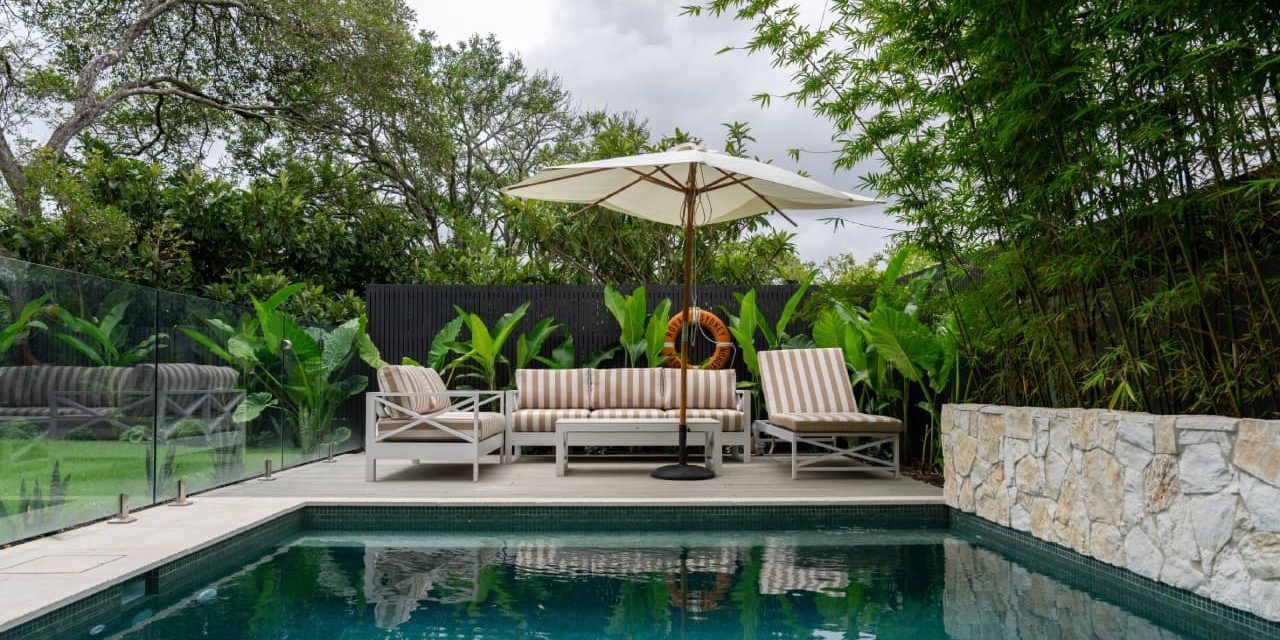
Careful positioning, structural coordination and considered material selection allowed a compact space to feel open and resolved.
Another layer that is critical is sun orientation. Close backyards may be influenced by the shadow of the neighbouring houses on the water temperature and use. An adequately located plunge pool takes into account the seasonal sun directions at an early stage.
Architectural alignment
We do not consider a plunge pool as an isolated feature at Space Landscape Designs. The geometry should respond to the home. Modern architecture requires clean and subdued shapes.
We tend to project interior materials externally so that the pool can be naturally located in the larger outdoor composition. Sightlines from kitchens and living areas are carefully framed so the water becomes part of the daily experience.
Working with slope
Several sites in Sydney entail fall across the block. Rather than fighting it, we integrate it. Pools can be partially elevated, retained, or fixed into structural walls.
Early consultation with engineers is necessary. Drainage plan is also critical, especially when the adjacent properties are lower than the property.
Privacy in dense environments
Density in the cities introduces overlooking. Solid boundary walls are one solution, but they can compress a space visually.
In our inner-city plunge pool renovation project (view project), there was limited space and privacy was paramount. The pool was made a part of the architecture and not an addition to the backyard through the use of layered materials and detailing.
The detailing that defines quality
In small pools, details carry weight. The tone of the water is altered by interior finishes. The edge treatments determine the meeting of the pool with the paving. Seats and steps should be integrated and in a good proportion.
The lighting design prolongs the experience into the night. Subtle illumination can elevate a compact pool into a refined architectural feature after sunset.
Approvals and compliance
The design of pools in New South Wales has to operate within the regulatory frameworks. Setbacks, fencing requirements, structural certification and approval pathways influence feasibility.
Understanding these pathways early protects both timeline and design integrity.
The importance of experience on small sites.
During construction, there is space to make adjustments on large blocks. In crowded urban areas there is minimal tolerance. The plunge pools in
Sydney need to be designed with knowledge on architecture, structure, approvals and construction sequencing.
If you’re exploring the idea of a plunge pool, reviewing built projects is often the best place to start.